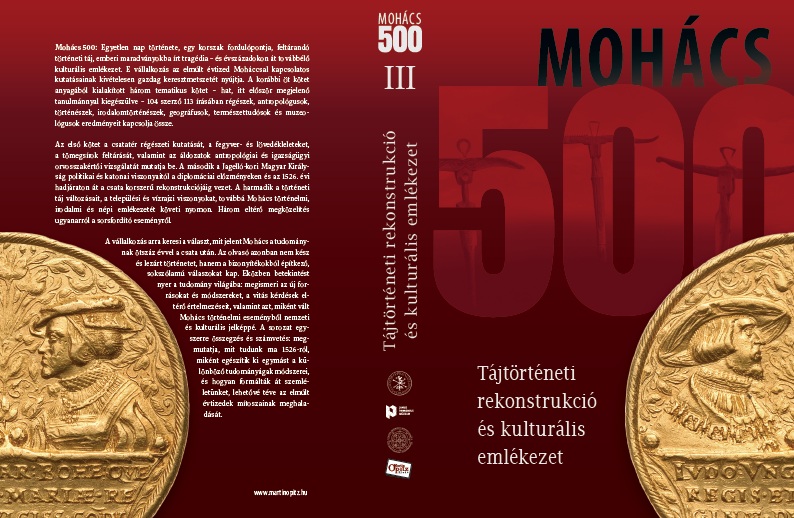
MOHÁCS 500 III. Tájtörténeti rekonstrukció és kulturális emlékezet (Historical Landscape Reconstruction and Cultural Memory)
Főszerk.: Varga Sz.; Szerk.: Major B. – Türk A. – Langó P. – Bertók G. – Haramza M.
Studia ad Archaeologiam Pazmaniensia 41.
Budapest-Pécs 2026.
ISBN 978-615-6998-24-8
HU-ISSN 2786-1538
HU-ISSN 2064-8162
DOI: 10.55722/Arpad.Kiad.2026.19.
Tartalom
KÖRNYEZET- ÉS TÁJREKONSTRUKCIÓ
Szabó Máté
Római kori adalékok Mohács térségének topográfiájához (Additions to the Topography of the Mohács Area in the Roman Period)
Dénes József
Földvártól Udvarig. Hol lehetett a Brodarics István tudósításában szereplő falu? (From Földvár to Udvar. Where was the Village Mentioned in István Brodarics’s Report?)
31
Sudár Balázs
A mohácsi náhíje és települései a 16–17. században (Nahiye of Mohács and its Settlements in the 16th–17th Centuries)
Sudár Balázs – Varga Szabolcs
A mohácsi kistérség települései a 17. század utolsó negyedében (The Settlements of the Mohács Sub-region in the Last Quarter of the 17th Century).
Végh András (†) – B. Szabó János
A Mohács és Danóc közé eső térség késő középkori birtok- és településstruktúrája (Late Medieval Estate and Settlement Structure of the Region between Mohács and Danóc)
Pánya István
Úttalan utakon. Adatok a késő középkori Bodrog vármegye úthálózatához (The Untrodden Roads. Data on the Road Network of Late Medieval Bodrog County)
Kiss Andrea
A kis jégkorszak, a Spörer-minimum és Mohács (The Little Ice Age, the Spörer Minimum and Mohács)
Szávoszt-Vass Dániel
Támpontok a Mohácsi-Duna medrének 1526-os rekonstrukciójához (Reference Points for the Reconstruction of the Mohács-Danube Riverbed in 1526)
Viczián István
A Duna domborzatformáló hatása Mohács környékén és az 1526. évi mohácsi csata (Fluvial Geomorphology of the Mohács Danube Floodplain and the Battle of Mohács in 1526)
Gábris Gyula
Természetföldrajzi észrevételek a mohácsi csatamező legújabb kutatásainak eredményeihez (Natural Geographic Observations on the Latest Research Achievements Connected to the Battlefield of Mohács).
Viczián István – Szeberényi József – Szávoszt-Vass Dániel – Drusza Tamás
A mohácsi teraszos sík holocén felszínfejlődése és az 1526. évi mohácsi csata környezetének vízrajzi és geomorfológiai rekonstrukciója (The Holocene Landform Evolution of the Mohács Terraced Plain: A Hydrographical and Geomorphological Reconstruction of the Presumed Site of the 1526 Battle of Mohács).
Szeberényi József – Viczián István – Drusza Tamás – Szávoszt-Vass Dániel
A Mohácsi-sík természetföldrajzi adottságai, település- és úthálózata a 16. században (A Topographical Study of the Geographical Situation of the Mohács Plain in 1526)
Viczián István – Szeberényi József – Drusza Tamás
A majsi Borza-patak szerepe a mohácsi csata földrajzi rekonstrukciójában (The Role of the Borza Stream at Majs in the Geographical Reconstruction of the Battle of Mohács)
Varga Anna
Az ártéri növényzet értékelése terepi és irodalmi adatok alapján a mohácsi csatatáj kutatásában (Analysis of the Floodplain Vegetation of the Mohács Military Landscape Research based on Field Studies and Literature Data).
NÉPI ÉS TÖRTÉNELMI EMLÉKEZET
Csepregi Zoltán
Templomrabló? Hitvalló? Szerencselovag? Stratéga? Brandenburgi György őrgróf (1484–1543) a történetírásban (Church Robber? Pious? Venturer? Strategist? Margrave George of Brandenburg (1484–1543) in Historiography)
Ferkov Jakab
Az oszmán megszállás megszűnése utáni etnikai viszonyok kialakulása a délkelet-baranyai térségben (Development of Ethnic Relations in South-eastern Baranya after the end of Ottoman Rule).
Máté Gábor
A tájjal kapcsolatos népi emlékezet struktúrája és jelentősége a mohácsi csatatér kutatásában (The Structure of Landscape-related Oral Traditions and its Importance in the Study of Mohács Battlefield)
Máté Gábor
Népességcsere, nyelvi viszonyok, faluhatárok a 18. századi tanúvallatások fényében, Mohács térségében (Population Change, Linguistic Proportions and Village Boundaries in the Light of 18th-Century Border Investigations in the Mohács Area)
Gőzsy Zoltán – Varga Szabolcs
A mohácsi csata emlékezete Pesty Frigyes helynévgyűjtésében (Memory of the Battle of Mohács in the Inventory of Placenames by Frigyes Pesty)
IRODALMI EMLÉKEZET ÉS MŰVÉSZETI RECEPCIÓ
Mackay, Christopher S.
Brodarics Verissima historiájának első kiadása: háttér és kontextus (Background and Context of the 1527 Edition of Stephen Brodericus’s Verissima Historia)
Szebelédi Zsolt
Szerémi György Mohács-képe (György Szerémi’s Vision of Mohács)
Kasza Péter
Zermegh-kontextusok (Zermegh Contexts).
Varga Szabolcs
Brodarics István és Istvánffy Miklós mohácsi csatáról szóló leírásának összehasonlítása (Comparison of István Brodarics and Miklós Istvánffy’s Accounts on the Battle of Mohács).
Sudár Balázs
Két török költő a mohácsi csatáról: Mahremí és Eszírí (Two Ottoman Poets on the Battle of Mohács: Mahremī and Esīrī)
Sudár Balázs
Újabb forrás Mohácsról. Egy másik Dzselálzáde: Szálih cselebi (A New Source on the Battle of Mohács: the other Celalzade, Salih Çelebi).
Fóti Miklós
Hindi baba jövendölése Szulejmán szultán győzelméről a mohácsi csatában: legenda és valóság (The Prophecy of Hindi Baba about the Victory of Sultan Suleiman in the Battle of Mohács: Myth and Reality)
Varga Szabolcs
A mohácsi csata emlékei Boszniában (Memories of the Battle of Mohács in Bosnia).
Hende Fanni
Kódextöredékek Szigetvárról (Codex Fragments from Szigetvár)
Orsós Julianna
A mohácsi csata Joszéf ha-Kohén ábrázolásában (The Battle of Mohács in the Chronicle of Joseph ha-kohen)
Polgár Balázs
A „második mohácsi csata” (1687) ábrázolása a Bibliothèque Nationale de France gyűjteményéből (A Depiction of the “Second Battle at Mohács” [1687] from the Collection of the Bibliothèque Nationale de France)
Maczák Ibolya
Mohácsi események Illyés István Szent György napjára írt prédikációiban (Events Related to the Battle of Mohács in István Illyés’s Sermons Written for St. George’s Day)
S. Laczkó András
„Nemzeti nagy bűnnek nagy torolója Mohács”. Czuczor Gergely Mohács-epigrammájáról (“The Avenger of a Great National Sin: Mohács.” Gergely Czuczor’s Epigram)
S. Laczkó András
Az állandóság változatai. A Mohács-toposz használata a 18–19. századi költészetben (Versions of Permanence. The Use of the Topos ‟Mohács” in 18th–19th-Century Hungarian Poetry).
S. Laczkó András
„Szűk vala egy ország…” Kisfaludy Károly Mohácsának Tomori-képe (“A country was too narrow for thee...” Portrait of Pál Tomori in Károly Kisfaludy’s Mohács).
S. Laczkó András
„’s még áll Mohács…” Az 1526. évi csata reformkori költői reprezentációiról (“And Mohács still stands…” Poetic Representations of the Battle of Mohács [1526] in the Reform Era)
Papp Júlia
„A mohácsi temetés”. Perényi Imréné Kanizsai Dorottya az irodalomban és a képzőművészetben (“The Funeral of Mohács”. Imre Perényi’s Widow, Dorottya Kanizsai in Literature and the Visual Arts)
Lakatos Adél
Tomori Pál érsek alakja az 1896. évi millenniumi kiállítás kalocsai előkészületeiben (The Figure of Archbishop Pál Tomori in the Preparations for the 1896 Millennium Exhibition in Kalocsa)
Kanász Viktor
A mohácsi csata és II. Lajos király az ex libriseken (The Battle of Mohács and King Louis II on Ex Libris)
KULTURÁLIS ÖRÖKSÉGVÉDELEM
Polgár Balázs
Történelmi csatatereken – Harsány-hegy (1687), Kismegyer (1809) és Segesvár (1849) (At Historical Battlefields – Harsány Hill [1687], Kismegyer [1809] and Segesvár [1849]).
Polgár Balázs
Történelmi csataterek kulturális örökségvédelme Magyarországon (Cultural Heritage Protection of Historic Battlefields in Hungary)
Négyesi Lajos
A mohácsi csata emlékhelyei (Memorial Sites of the Battle of Mohács)
Kanász Viktor – Nagy Katalin
Burgio nuncius árnyékában. A budapesti nunciusok és Mohács emlékezete (In the Shadow of Nuncio Burgio. The Nuncios of Budapest and the Memory of Mohács)
Hasanovic-Kolutácz Andrea
Az 1526. évi mohácsi csata a mohácsiak emlékezetében (The Battle of Mohács in 1526 in the Memory of the Inhabitants of Mohács)
Hasanovic-Kolutácz Andrea
A mohácsi csata 450. évfordulója alkalmából rendezett emlékkiállítás a Kanizsai Dorottya Múzeumban (Memorial Exhibition on the Occasion of the 450th Anniversary of the Battle of Mohács at the Dorottya Kanizsai Museum).
Kárpáti Kata
Mohács500 Múzeumakadémia. A közgyűjtemények és köznevelési intézmények együttműködése. Emlékezetpedagógiai koncepcióterv (Educational Concepts and Approaches of Interpreting the Battle of Mohács)
Kovács István
Kegyelet – hősiesség – közép-európai összefogás. A Nemzeti Örökség Intézete „Mohács500” projektje és eddig elért eredményei (Piety – Heroism – Central European Unity. The “Mohács500” Project of the National Heritage Institute and Its Results So Far)