
Erwin Gáll: Sources of Power in the 10th century Carpathian Basin. Conquest and Integration
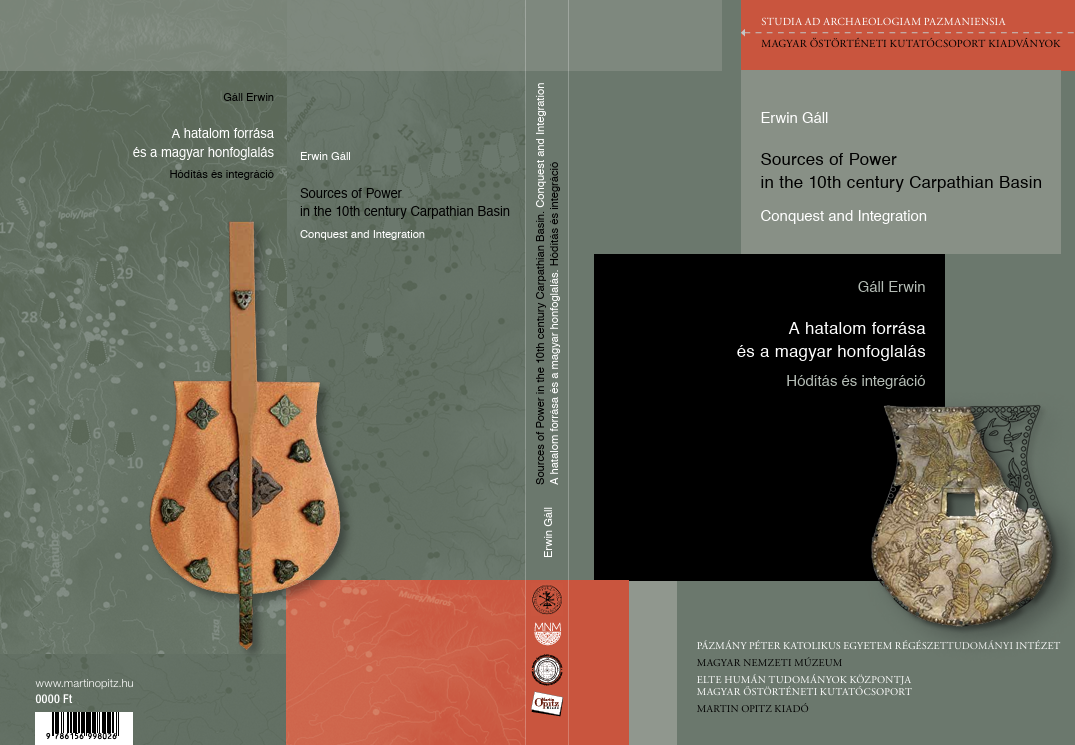
Erwin Gáll: Sources of Power in the 10th century Carpathian Basin. Conquest and Integration.
Editors: Gergely Szenthe - Attila Türk
Studia ad Archaeologiam Pazmaniensia 34. Magyar Őstörténeti Kutatócsoport Kiadványok 12. Budapest 2025
ISBN 978-615-6998-00-2
HU-ISSN 2064-8162
HU-ISSN 2786-1538
DOI 10.55722/Arpad.Kiad.2025.12

Tartalomjegyzék:
|
Introduction |
9 |
| I. The sources of Early Hungarian history | 11 |
| I.1. Written sources | 11 |
| I.2. Linguistic sources | 12 |
| I.3. Archaeological sources | 13 |
| I.4. Ethnography, cultural anthropology as a source of Hungarian prehistory | 16 |
| II. Power formations in the Steppe region: “nomadic rivalry” and the problem of nomadic group identity | 17 |
| III. Europe and “Eastern Europe” in the 6th–10th centuries | 23 |
| III.1. Europe and “Eastern Europe” as historical concepts | 23 |
| III.2. “Eastern Europe” in the 6th–10th centuries | 24 |
| III.3. “Eastern Europe” and archaeological evidence from the 6th–10th centuries | 29 |
| IV. The sources of power – “Hungaria” as a political synthesis. Hungarian ethnicity and “original homelands” in the light of historical theories: The origins of the Hungarian “steppe state”, its emergence, and the problem of dual governance | 38 |
| IV.1. The problem of Hungarian ethnicity and “original homeland(s)” in the light of historical theories | 38 |
| IV.1.1. Theories on the Ural homeland | 40 |
| IV.1.1.1. Ural → Levedia→ Atelkuzu/Etelköz → Carpathian Basin | 40 |
| IV.1.1.2. Ural → “Magna Hungaria” → Atelkuzu/Etelköz → Carpathian Basin, the so-called theory of “quick migration” | 40 |
| IV.1.1.3. Ural → “Caucasus” → Atelkuzu/Etelköz → Carpathian Basin | 42 |
| IV.1.2. The theory on the “three kingdoms of Scythia” | 44 |
| IV.1.3. The theory concerning the “Caucasus-homeland” | 45 |
| IV.1.4. Archaeology and the “absence of original homeland” | 47 |
| IV.2. Cautious reflections on the above theories | 48 |
| IV.2.1. Archaeological evidence and the localization of “original homelands” | 48 |
| IV.2.2. The Savard Hungarians, the localization of their territory in the light of archaeological evidence | 52 |
| IV.3. The origins of the Hungarian steppe state, its formation and character | 53 |
| IV.4. The dual structure of the Hungarian “steppe-state” | 54 |
| IV.5. Atelkuzu/Etelköz – the problem of its localization in the light of recent archaeological research | 55 |
| V. The new homeland – the natural geography of the Carpathian Basin | 59 |
| V.1. The Carpathian Basin | 59 |
| V.2. Mineral resources of the Carpathian Basin | 61 |
| VI. The “odd” 9th century in the Carpathian Basin – geopolitical developments before the Hungarian Conquest | 65 |
| VI.1. The western part of the Carpathian Basin as a region of “Europe” | 65 |
| VI.2. The eastern peripheries and the Bulgarian conquest | 67 |
| VII. The Hungarian Conquest as a military political phenomenon. The Hungarian Conquest: a successful escape or a military “project”? The routes of Conquest – the shackles of conventional interpretations | 75 |
| VII.1. Conquest-period Hungarians and the Carpathian Basin in the 9th century | 75 |
| VII.2. A successful escape or a military “project”? | 76 |
| VII.3. The possible routes of the Hungarian conquest and the limits of interpretations | 77 |
| VIII. “Sagittis Hungarorum libera nos Domine”. The victorious decades after the conquest: “incursions” or strategic campaigns? The geopolitical context in the first 70 years of the 10th century | 83 |
| VIII.1. The Hungarian “steppe state” and the problem of territoriality in the Carpathian Basin | 83 |
| VIII.1.1. Against whom? | 84 |
| VIII.1.2. Against whom not? | 85 |
| VIII.1.3. Strategic campaigns or tribal looting? | 86 |
| VIII.2. The chronology of the campaigns | 87 |
| IX. The Carpathian Basin in the 10th century and the conquering Hungarians | 89 |
| IX.1. Theories on the numbers of the conquering and conquered populations | 89 |
| IX.2. Structure of the Conquest-period soci | 92 |
| IX.3. Theories on the organization of the economy in the 10th century | 93 |
| IX.4. Some remarks | 94 |
| IX.5. 10th-century costumes in the Carpathian Basin. Asymmetric cultural influences in the light of archaeological data | 94 |
| X. The Carpathian Basin in the 10th century. Its population and the archaeology of its regions: Introduction | 99 |
| X.1. The Upper Tisza region as the “core” region in the 10th century | 100 |
| X.1.1. Analysis of 10th century burial sites and graves in the Upper Tisza region | 100 |
| X.1.2. Significance of 10th-century burial sites in the Upper Tisza region | 109 |
| X.2. The Transylvanian Basin as a periphery in the 10th century | 112 |
| X.2.1. Analysis of 10th-century burial sites in the Transylvanian Basin | 112 |
| X.2.2. 10th-century burial sites and Transylvania as a “periphery”. The “peripheries” of a peripheral region | 118 |
| X.3. The Trans-Tisza region and the Banat in the 10th century | 121 |
| X.3.1. 10th century burial sites in the region north of the Körös/Criș | 121 |
| X.3.2. 10th century burial sites in the Körös/Criș–Tisza/Tisa–Maros/Mureș region | 126 |
| X.3.3. 10th century burials in the Banat | 132 |
| X.4. The Danube–Tisza Interfluve and Syrmia in the 10th century | 137 |
| X.4.1. The southern part of Bačka and Syrmia | 138 |
| X.4.2. The Danubian Lowland, the Danube–Tisza Sand Ridge (Homokhátság) and the Lower-Tisza Valley | 139 |
| X.4.3. Summary – the 10th century archaeology of the Danube–Tisza Interfluve and Syrmia | 150 |
| X.5. Upper Hungary and the northern part of the Little Hungarian Plain in the 10th century | 152 |
| X.5.1. Analysis of 10th century burials in Upper Hungary and in the northern part of the Little Hungarian Plain | 152 |
| X.5.2. Summary | 162 |
| X.6. The “Transdanubia phenomenon” in the 10th century – the western- southwestern periphery of the Hungarian nomad power? | 165 |
| X.6.1. Analysis of 10th-century burials in Transdanubia | 165 |
| X.6.2. Summary | 174 |
| X.7. The “steppe state” beyond the Carpathians? | 177 |
| X.7.1. The problem of Conquest period “Hungarian” finds to the east from the Carpathian Basin | 180 |
| X.7.2. “Polak, Węgier – dwa bratanki, i do szabli, i do szklanki”? The problem of 10th-century finds in Lesser Poland | 186 |
| X.7.3. “Drang nach Westen?” What happens west of the Carpathian Basin? | 187 |
| XI. The 10th century archaeology of the Carpathian Basin – a summary: Core Areas, Inner Peripheries, and ‟Borders” | 191 |
| XI.1. The expansion of the Hungarian power structure in the light of archaeological data. The research problem of the “Machtbereich” and the “Siedlungsbereich” | 191 |
| XI.2. The issue of 10th century nomadism and archaeological evidence of settlement in the Carpathian Basin | 201 |
| XII. Appendix. Salt occurrences in the Transylvanian Basin (by Ferenc Wanek) | 209 |
| XIII. Bibliography | 217 |
| XIII.1. Primary Sources | 217 |
| XIII.2. Secondary Sources | 217 |
| Annexes. List of the sites (Maps 1–3) | 251 |

